
Six Musical Alphabet Interval Patterns
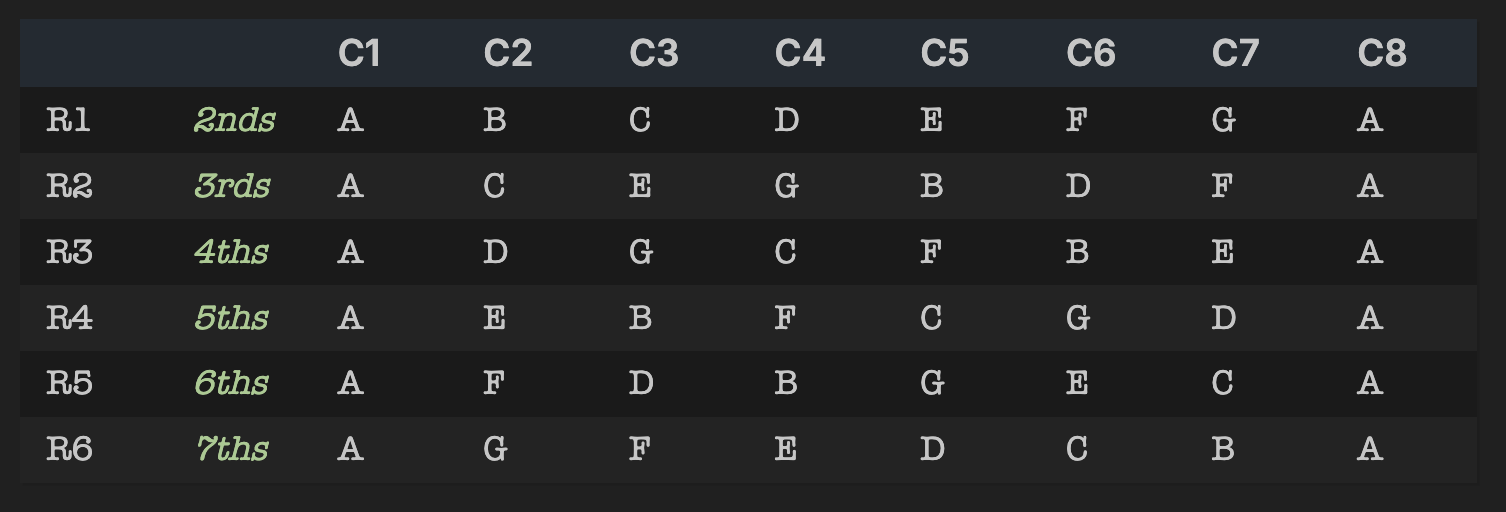
Learning the musical alphabet in six distinct interval patterns is a valuable skill for every musician. Developing the ability to recognize and perform these patterns as loops—where the sequence cycles continuously—is especially beneficial. Each pattern below has practical applications in theory, analysis, and performance.
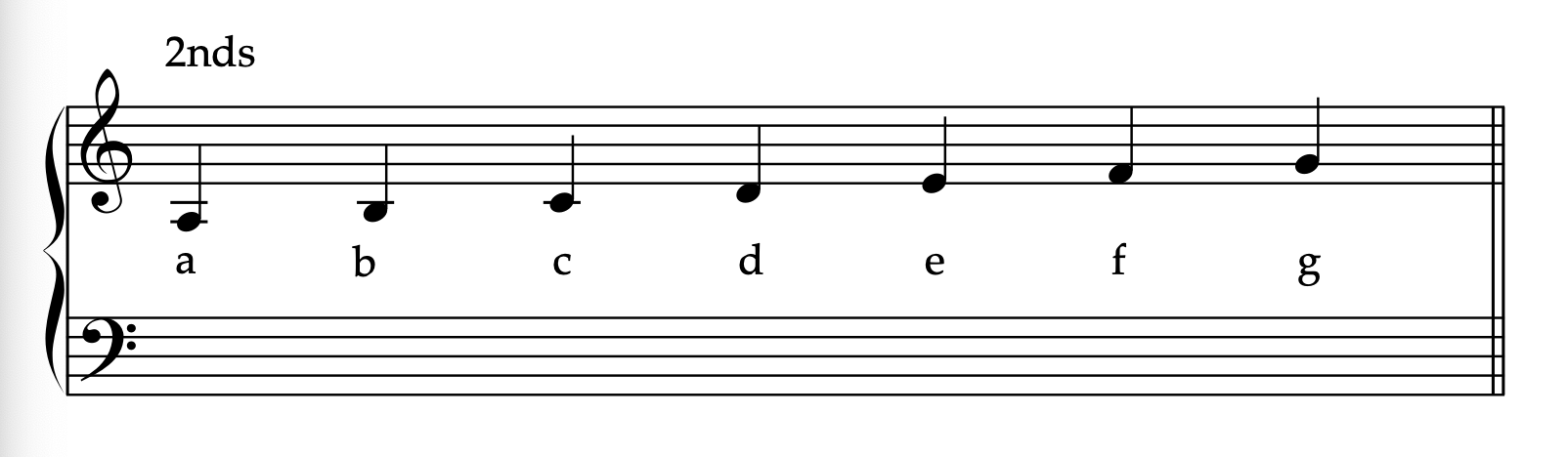
R1 - Seconds
R1 represents a sequence of seconds. Major, minor, and modal scales all progress in seconds. Being able to visualize the musical alphabet beginning on any of the seven letter names and cycling back to the starting point helps musicians conceptualize scale sequences more fluently.
R2 - Thirds
R2 outlines a sequence of thirds. Chords are constructed by stacking thirds. For instance, the A minor triad (A–C–E) corresponds to the first three notes of R2. On the staff, intervals of a third are easy to recognize since they appear as notes either on successive lines or in successive spaces.
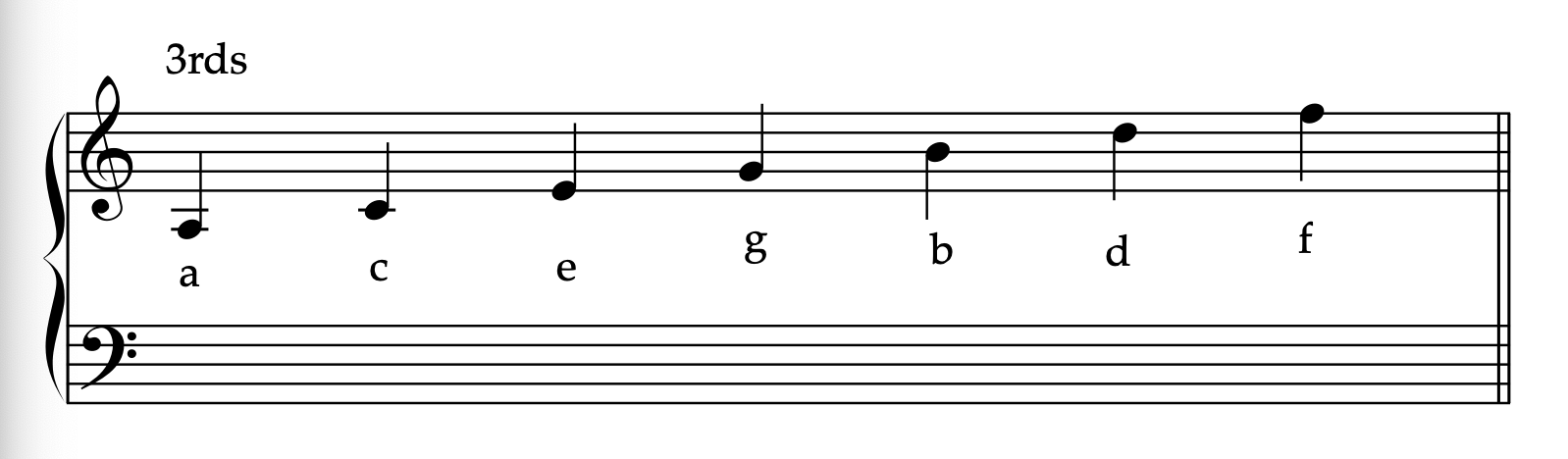
Treble clef: lines E–G–B–D–F, spaces F–A–C–E
Bass clef: lines G–B–D–F–A, spaces A–C–E–G
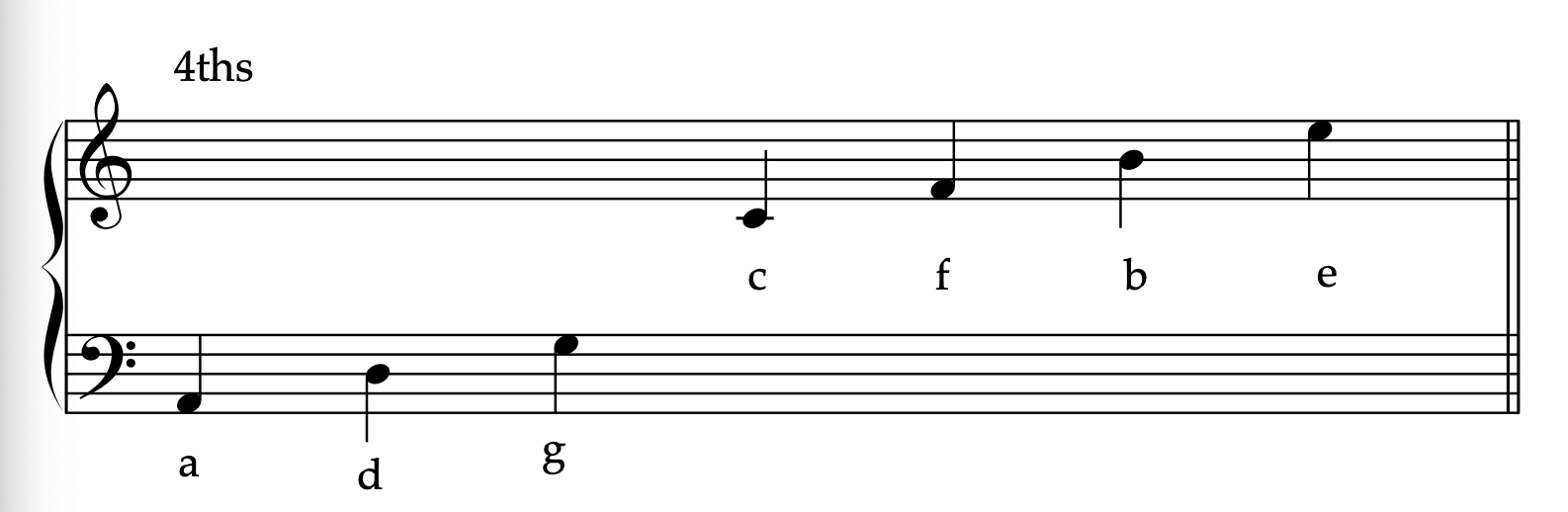
R3 - Fourths
R3 is a sequence of fourths. This pattern underlies the order of flats in key signatures, which always appear in the fixed order B–E–A–D–G–C–F. Understanding R3 allows musicians to think quickly in terms of the circle of fourths, a fundamental concept that mirrors the circle of fifths. It follows this order: B♭–E♭–A♭–D♭–G♭–C♭–F♭–B𝄫–E𝄫–A𝄫–D𝄫–G𝄫–C𝄫–F𝄫–etc.
R4 - Fifths
R4 forms a sequence of fifths. The order of sharps in key signatures follows this pattern: F–C–G–D–A–E–B. Mastering R4 supports a clear understanding of the circle of fifths, one of the most important tools for analyzing harmonic relationships and tonal movement. It follows this order: F–C–G–D–A–E–B–F♯–C♯–G♯–D♯–A♯–E♯–B♯–F𝄪–C𝄪–G𝄪–D𝄪–etc.
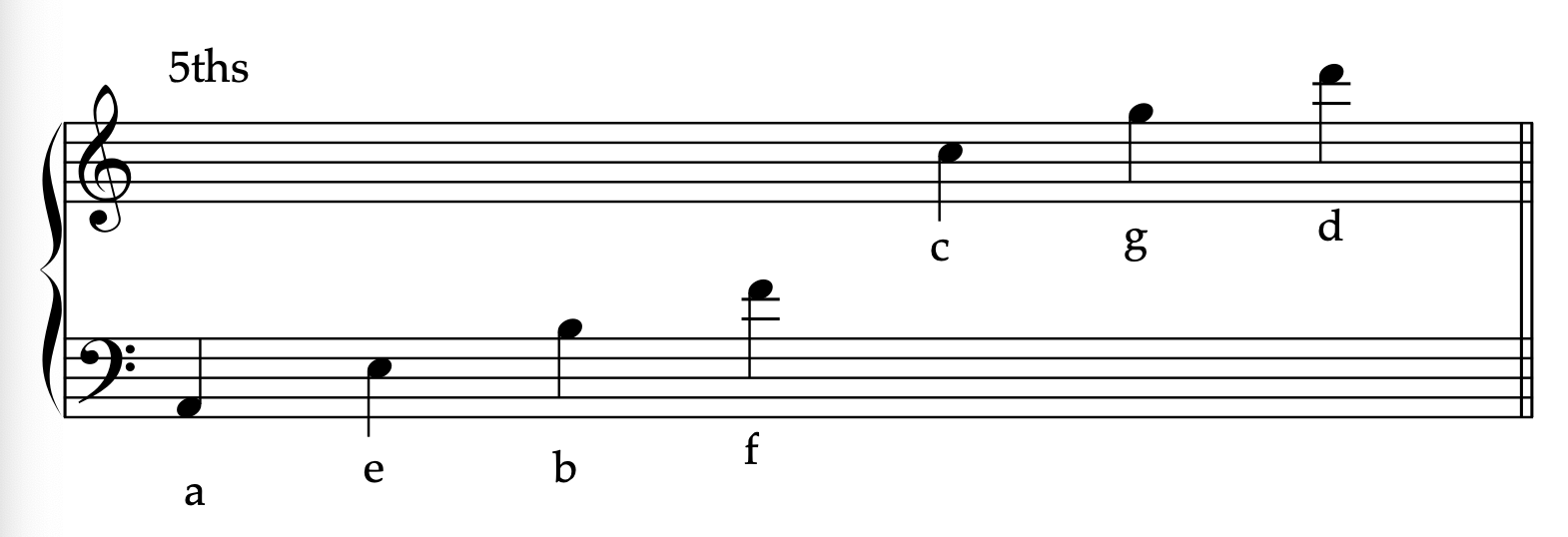
R5 - Sixths
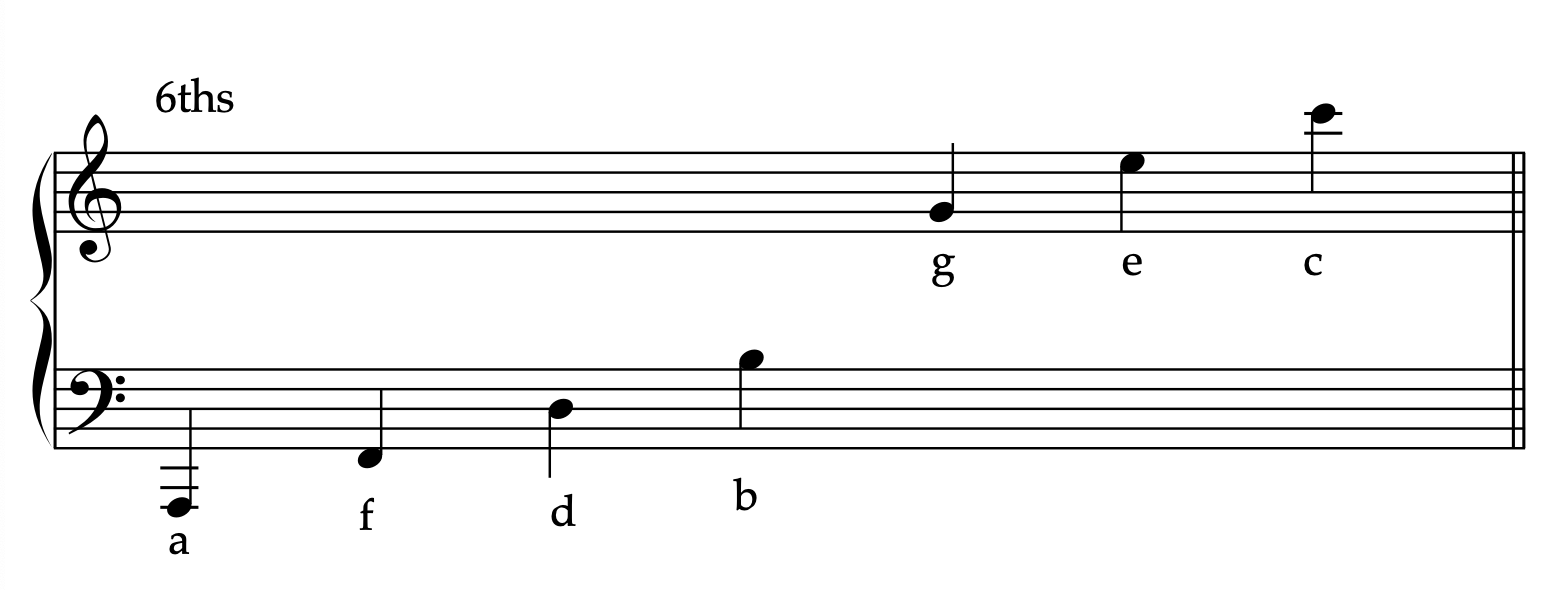
R5 outlines a sequence of sixths. Each major key has a relative minor a sixth above. For example, C major and A minor share the same key signature. Knowing the R5 pattern provides a quick way to identify these relative relationships across all keys.
R6 - Sevenths
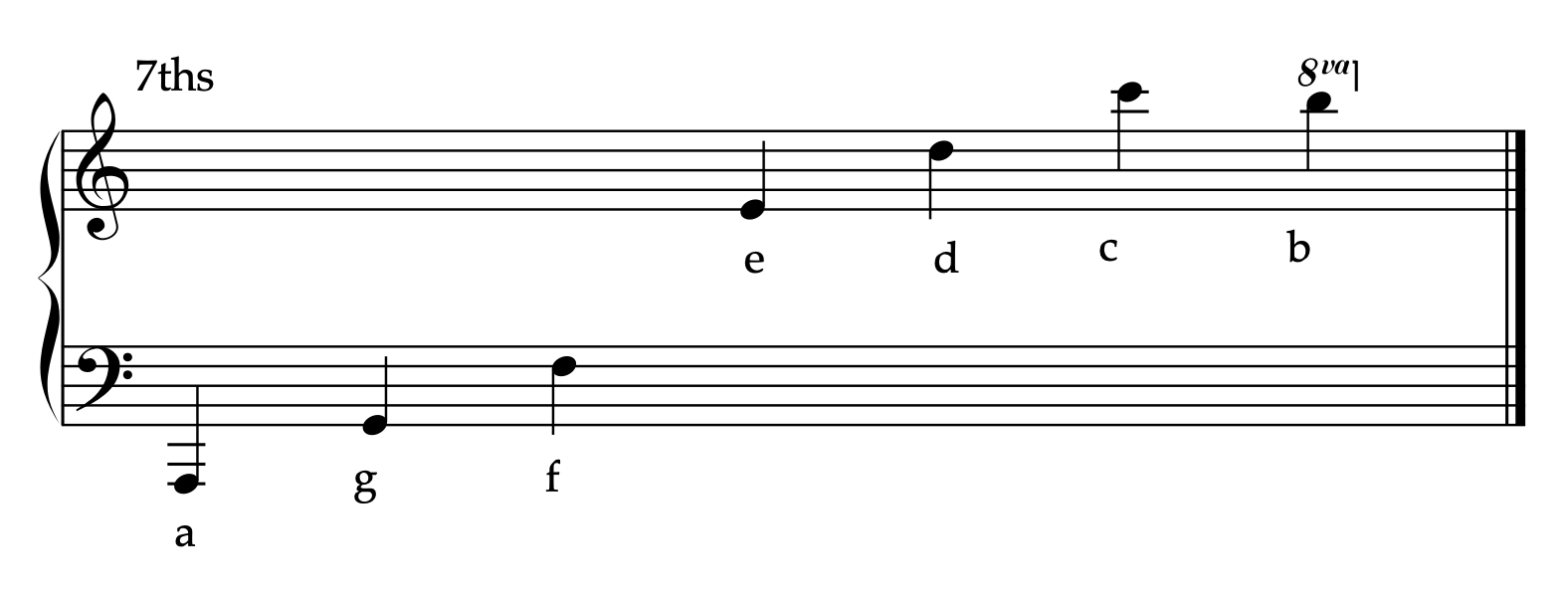
R6 represents a sequence of sevenths. The interval of a seventh defines the relationship between the root and the seventh of a dominant seventh (V7) chord. For instance, a D7 chord contains the notes D–F♯–A–C; the distance between D and C is a seventh. Recognizing R6 helps musicians internalize the structure of dominant harmony.
Inverse Relationships
Each of the six alphabet patterns has a corresponding inverse pattern. These inverses mirror one another in direction and intervallic structure:
R1 and R6 — Inverse pair. Moving upward from C1 to C8 in R1 produces the same sequence that results when moving downward from C8 to C1 in R6.
R2 and R5 — Inverse pair. Each represents the reverse motion of the other through intervals of thirds and sixths.
R3 and R4 — Inverse pair. The fourths sequence (R3) mirrors the fifths sequence (R4) in the opposite direction.
Conclusion
Mastering the six interval patterns and their inverses strengthens a musician’s understanding of tonal organization. These relationships link scales, chords, and key signatures into a unified framework, allowing faster mental navigation of the musical system. Practicing them as looping sequences develops fluency that transfers directly to analysis, improvisation, and composition.
— Carlos Rios
Founder, SPuR School of Music